
THE QUEEN'S COURAGE WHEN FACED WITH A CROWD WANTING TO KILL HER CONTRADICTS HER FRIVOLOUIS IMAGE
-- Pages based on Histoire de la Révolution française, the classic by Jules Michelet (1853).
On October 5, 1789 7-8,000 women seize arms at City Hall and march on Versailles, to demand grain and bring the king back to Paris.

Fuite de Passy à Versailles, a famous print (Passy is a wealthy suburb on the route to Versailles) / zoom

Militants threaten to cut the hair of women who do not join them.
"The certain cause, for the women, for the crowd of the most miserable, was hunger. Having made a rider dismount, they killed the horse and ate it almost raw.
Would the men have marched on Versailles if the women had not preceded them? Probably not. No one had had the idea of going to find the king."
Michelet on the women's engagement:
"Great misery is fierce, it strikes the most feeble."
Women were more exposed to hunger than men because more isolated, with children who cried and died, or seamstresses who worked alone (he does not mention washerwomen, whose work was sociable). Not all militants, he adds, were hungry, such as market-women and prostitutes, but misery surrounded them.
They wish to bring the king back to Paris:
"The King must live with his people, feel and share the suffering [...] If Kingship be not tyranny, there must be a mariage, a community [...] Is it not strange and unnatural, enough to dry the heart of kings, to keep them in selfish solitude, with an artificial crowd of golden beggars, to make them forget the people? How be surprised that such kings become hard and barbarous strangers?"
# # #
One woman seizes a drum from guards and beats as they advance through the streets. Others join them.
- Lafayette,* Head of the National Guard, tries ineffectively to stop them, then with his men tags along.
*Americans' only foreign hero was active in both revolutions.
 |
These photos and the next come from La Révolution française by Robert Enrico, 1989 |
The child is imaginary but the drumbeat's stirring call was real.
- Men disguised as women are said to join in.
 |
| Internet, no source named |
- The march is much tougher than the picture and movie show. The crowd walks the 12 miles to Versailles in mud, under cold October rain.
- Thousands of women arrive at Versailles toward 16h, Lafayette and the Guard a few hours later.
- The king receives a delegation of women (one faints from emotion on seeing him). He agrees to send grain to Paris and to sign the Declaration of the Rights of Man and the Citizen, and said he would think about coming to Paris.
- The throng camps out in the palace's huge courtyard:

# # #
At dawn on October 6, people break through the gates and seek to kill the queen:
 |
  |
- Chambermaids lock the door and help Marie-Antoinette throw on a dress:

Here and below, Marie-Antoinette by Jean Delannoy with Michèle Morgan, 1956
They flee by a secret passage that leads to the king's room, but he has left to look for them. They rush through the palace to find him. A locked door adds to the panic: It is five minutes before a servant hears the terrified pounding.
- Two guards who try to protect the queen are killed:
 |
"Massacre of a Guard at the Queen's Apartment, by brigands" print by J-F Janinent / zoom

- The queen and the chambermaids finally find the king, the children, their governess and Lafayette, in the salon that looks out on the courtyard:

Le General La Fayette met en garde le Roi et la Reine by Jean-Frédéric Shall, before 1825, zoom

- Louis refuses to let his troops fire on the crowd and tries to talk to it...


- But it demands the queen. When she comes out on the balcony with the children the mob screams, "No children!"


After the terrifying awakening and the frantic rush through the palace, Marie-Antoinette calmly faces the throng that has wished to kill her:

# # #
The king is forced to settle in Paris, asking only that his family come too. "The royal coach, La Fayette riding alongside it, advanced like a hearse."
-- Michelet. The account below comes from the memoir of Madame Campon, whose sister was present.
- His carriage leads the march, to drumbeats and the shooting of muskets. The mob is so close to the coach that it sways from side to side, carrying ahead of it the heads of the slaughtered guards on pikes. The court follows in a hundred coaches:
 |
| Zoom |
 |
La Fuite de Louis XVI by Viktor Lazarevski, 2013 / Youtube |
"In the midst of that troop of cannibals rose up the two heads of the massacred guards. The monsters, who had made trophies of them, had the atrocious idea of forcing a wig-maker to re-style their coiffures by powdering their bloodied heads...
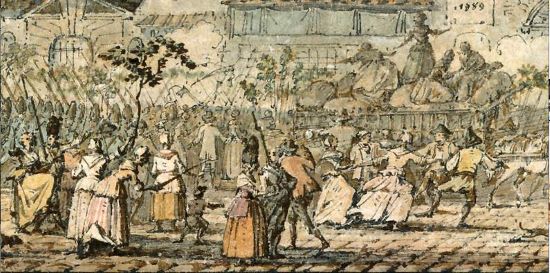
- Parisians celebrate the arrival of bags of grain and the royal family by dancing in the streets:

Louis XVI entre à Paris, le 6 octobre 1789 by J.F.J. Swebach, 1789 / zoom
# # #
If you visit the château of Versailles you will cross through the courtyard and pass under the balcony:

Think of the mob, the massacred guards and the courage of Marie-Antoinette.
# # #
The musée Carnavalet (the historical museum)
and skips this drama.
* * *


No comments:
Post a Comment