Saturday, October 30, 2010

VII. THE OVERLOOKED 13TH, A COMMUNARD BASTION


MENU: 7. A COMMUNARD BASTION

THE CITY'S SOUTHEASTERN FRINGE USED TO BE ITS POOREST AREA...  


Adapted from a Google map

In the east where prevailing winds blow pollution, next to the river and a railroad and an outskirt with inexpensive land, it became one of the most industrialized parts of France.

Raw capitalism made the once idyllic area a place of misery.

 Painting (detail) of an inn in the area toward 1820, anonymous (at today's Auberge Ethchegorry) 

Paris, 4 place Pinel "Les Chiffonniers" [The Ragmen ] by Eugène Atget, toward 1900 / for more photos from the National Library, zoom

This section explores that past. The next one shows how much it has changed, and how the hardship of the past is the background to its vitality today.

     Boulevard Auriol 

I live there.
The past

*    *    *
 
Next,


Monday, October 25, 2010

VII.1. THE FIGHT FOR THE HILLTOP

 MENU: 7.1. The fight for the hilltop


THE FIERCEST STRUGGLE OF BLOODY WEEK

The Last Day of the Commune, theater poster by Leon Choubrac, 1883 / zoom 

In brief

*   *   *


Next,


Sunday, October 24, 2010

FRENZIED COMBAT


THE BUTTE-AUX-CAILLES ("QUAIL HILLTOP"), SITE OF THE REPRESSION'S WORST FIGHTING

Elsewhere Versaillais officers spared unreliable troops, but they could not leave so strategic a height to the Communards. It took the government forces, which were six times more numerous, four attempts to seize the hill.
-- Lissagary

                                 The Observatory Seen from the Butte aux Cailles by Jean Millet, toward 1710 / zoom

"A perspective to delight 
the most blasé traveller [...]

The Panthéon's magnificent cupula, the drab and melancholy dome of the Val de Grâce, proudly dominate an entire town [...] From there, the proportions of the the two monuments appear gigantic [...] to the left, the Observatory seems a dark and gaunt spectre [...] then, from afar, the Invalides's elegant lantern flames between the Luxembourg's blue masses and the gray towers of Saint-Sulpice [...]" 
-- The Woman of Thirty by Balzac, 1842 

First they avoided the barricade that guarded the entry* to the 13th, by advancing under fire along the islands of the Bièvre river:

*Les Gobelins, the famous site of tapestry production since the 17th century. It is still where the district begins.

Zoom (please scroll down)

Then their climb gently began...

Parc René Le Gall
The park is built on enlarged islands.


Across what was then a track... 

Now boulevard Auguste Blanqui 
It linked the gate at the city's entrance with place d'Italie, site of City Hall and the prison where the monks would soon be killed.

The height was across from it. After the four tries mentioned, under heavy fire, they took it toward 4 p.m.

           Engraving of the time, gone from the web


The Brassai garden

The thousand surviving Communards retired to the right bank in good order, where they dispersed to defend their neighborhoods.  

# # #


The terrified residents a few streets away.
heard the screams and gun shots.
(For the site now, please click and scroll down.)

*    *    *
Next, 


Saturday, October 23, 2010

COMMUNARD FIGHTERS


THE HILLTOP LOST, GENERAL WALERY WROBLEWSKY REFUSED THE COMMAND OF THE REMAINING TROOPS AND FOUGHT ON AS AN ORDINARY SOLDIER:

        Mosaic outside the seat of Les amis de la Commune
The Polish nobleman exiled for participating in the insurrection of 1863 survived in Paris by lighting street lamps, then as a typographer.

La Commune defeated, he managed to flee to England. With the help of Marx, Engels and Polish refugees he founded a printing establishment and published Lissagary's account. He returned to Paris in 1885. He died there in 1908, deeply admired by the Polish community but extremely poor
-- Unsigned article in a publication of Les Amis de la Commune, n° 33, 2008. 

# # #

The legendary 101st battalion: "Rage alone commands those demons," of the 13th or Mouffetard,* "undisciplined, hoarse, with torn clothes and banner, who mutiny if they rest and as soon as
they have been withdrawn from battle, must be plunged into it again."
  -- Lissagary
*Where Hemingway hears Communard memories.

Sérizier, the commander:

       Cover photo
            Eléments de l'histoire de la Commune du 13e arrondissement by Gérard Conte, 1989
 
Marie Jean-Baptiste Sérizier wears his cap boldly to the side and looks intensely into the camera as he leans against his sword.  

A Communist tanner and militant,
he blustered, drank, beat his wife
and was an extremely brave and effective soldier.

For his last fight,
please click back.

*     *     *

Wednesday, October 13, 2010

A PANEL DOES MENTION LA COMMUNE AND THE FIGHTING, BUT...

 
IT CONTAINS ERRORS, MUCH OF THE DATA IS IRRELEVANT AND IT IS HIDDEN AWAY

History of Paris
Communards on the Butte-aux-Cailles


"After the seige of Paris the government that has taken refuge in Versailles tries to restore orderin Paris held by the Commune. The Butte aux Cailles, then sparsely inhabited and whose steep slopes dominate the Bievre river, is the theater of a bloody battle on May 25. The guards have their headquarters there. **


*Restore order: a euphemism for taking control. Paris was exceptionally calm (please click and scroll down).

**Their headquarters were the Gobelins manufactory, which barricades surrounded. Using the islands of the Bievre avoided them. 

Their leader, Wroblewski, protects its access by ambushes and light artillery fire.

[...] The Versaillais are pushed back several times, but at the end of the day hold place d'Italie — then place Émil Duval, counselor and Communard general shot in April [irrelevant— and the hill, while numerous insurgents retreat to the right bank of the Seine.  

# # #

Most of the city's 700 panels are on the street where they are  noticed, but this one is placed inside the passage that leads to the hill. 


You must take the little-used passage to see it.  


Ignorance and irrelevance as elsewhere,
 invisibility added. 

End of this section.

*    *    * 
Next section,


Thursday, September 9, 2010

VII.2. AN EPICENTER OF MISERY

MENU: 6.2. An epicenter of misery  

"THE 13th DISTRICT IS BY FAR THE MOST MISERABLE OF PARIS WHERE THE MOST TOXIC ELEMENTS OF ITS POPULATION FIND REFUGE"
-- Belinda Carter, Suffering Paris, "Paris treizième" (in French)


Zoom

Fog on Tolbiac bridge by Léo Malet (first published 1956), illustrated by Jacques Tardi (Castermann, 1988)

"Get out of here, Belita. 
Go dump your flowers wherever you like,
but get out of this place.
It will crush you, as it has others.  
 It stinks too much of misery, shit and misfortune." 

# # #

The story until the 1970's


*    *    *

Next,


Tuesday, August 24, 2010

DISEASE, CRIME AND REVOLT


THE SHAME OF PARIS, CITÉ JEANNE D'ARC
(BUILT IN 1884)

"The modern Court of Miracles... those who live there have fallen 
to the last rung of misery."
-- Belinda Carter, Paris treizième

Rue Jeanne d'Arc seen from the church steps (toward 1900) 
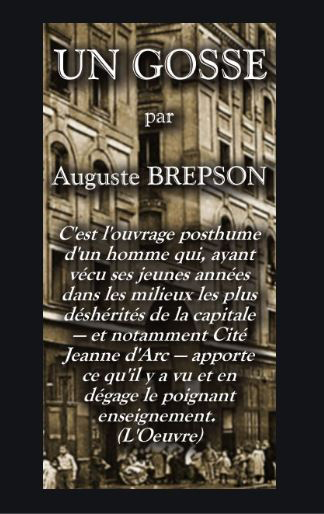
The posthumous account of a man who
 spent his youth among the most indigent
of the capital — notably of Cité Jeanne d'Arc — 
and tells what he has seen...


Disease  

In its dark, funereal corridors, among the stairs, corners and sordid recesses and in the midst of its shadow, the infection lurks and prowls, always in search of prey, the devouring specter: tuberculosis.
 -- A Kid, autobiographical novel by Auguste Brepson, 1927


Crime: 
The young man
in the postcard below
wears the cummerbund
of the "apaches,"*
the first modern street gangs.

*From the frightening reputation of the American West's Apaches 

The cummerbund, often red

Zoom (please scroll down)

The costume was that often worn by métro diggers from the region of Limousin, who won major strikes in 1901. The apaches appropriated it for its prestige and because evoking strikers showed that they did not work.

Revolt: The cité becomes a bastion of resistance to the government (in May 1934). That was the start of the turbulence that leads to the victory of the Socialist Popular Front* (1936-1939).


  Rue Nationale

When a Communist deputy from the 13th urges workers to vote, he is assaulted and arrested. Residents build barricades at both entrances to the cité and light fires in front of them (surely remembering La Commune), throw everything the can get their hands on at the police (as in the early 1830's and 1848), and push them back twice

The whole neighborhood has risen up, acclaiming the defenders of the cité who sing the Internationale and acclaim the soviets.
-- Paul Vaillant-Couturier, editor of l'Humanité (the Communist daily),
cited in Histoire et histoires du 13e, n° 6, winter 2011.

# # #

Remains of the cité: this sign... 


On the corner of rues Jeanne d'Arc / Docteur Victor Hutinel


The ensemble opened in 1884 was made up small streets whose entrance was an arcade. Divided into dwellings without comfort, the cité became slum in a neighborhood  undergoing rapid industrialization (the Austerlitz station, warehouses, the Say refinery, automobiles [...], the Lombart chocolats. A center of revolt as much as of squalor and delinquency, the Cité Jeanne d'Arc brings muscular repression, but also philanthropy.

In 1934 a precursor of the Popular Front appears: the insurgents raise barricades against the police, with the support of André Marty [the Communist deputy mentioned above], which led to the cité being demolished in 1938.

And the name "Résidence Jeanne d'Arc," for this City-run housing for the elderly:


Those are the only traces.

*     *    *
Next,
7.2.3,
Third-World revolutionaries' training ground