Showing posts with label 2.7.2. Backers sex & money. Show all posts

Saturday, October 28, 2017

II.7.2. BACKERS, SEX AND MONEY

 MENU: 2.7.2. Backers sex & money

OUR GUIDE STRIDES THROUGH AN EMPTY PASSAGE
TOWARD A BOARDED-UP DOOR

To the right of the passage is the salon of the "abonnés" (subscribers), Paris's wealthiest men. 

That salon is at the monument's heart. 

Cyprian Leym
In brief


*     *     *

Next,


Friday, October 27, 2017

THE ABONNÉS FINANCE PERFORMANCES


THOSE TYCOONS FINANCED THE SHOWS BY RESERVING THE MOST EXPENSIVE SEATS 

They might use them for their families or visitors from the provinces, on Tuesdays, Wednesdays or Fridays for a year...

By Honoré Daumier

But the main attraction was dinner in a salon next to the now sealed-off door the last page shows. There leaders of industry, commerce and culture connected, and met the most venerable nobility in a context as intimate and exclusive as that of a salon... while waiting for the end of the ballet inserted at the end of operas' second act.

They reached it through an entrance created for them alone, after leaving their carriages in the huge space next to their rotunda. 

 This view, 
from a window of the passage on the last page,
 is the only way to perceive the void: more later.  


The rectangles cover tables of a restaurant that occupies a third of the void.


Thursday, October 26, 2017

DETOUR: BALLET, AN ART OF THE FRENCH COURT

 
IT BEGAN AS PROCESSIONS THAT ROYALS LED
(FROM ABOUT 1560)

     The Ball by Abraham Bosse, 1634 / zoom 

Ritualized dances followed:  

Maurice Leloir in Richelieu by Théodore Cahu, 1901, a history of France for children

Then young members of the court performed allegories about the royals. In his youth Louis XIV, an excellent dancer, starred in the role that led to the name of "Sun King."

Maurice Leloir in Le Roy-Soleil by Gustave Toudouze, 1931

Later he established the first school for ballet and ordered that a  performance be inserted after the second act of every opera produced at court.

 The Man with the Iron Mask by R. Wallace with Leonard Dicaprio as Louis (1998) and Le roi danse by G. Corbiau (2000) 


Coded dance was part of court life until the end of the Old Regime:

The Princess of Navarre by Nicolin Cochin, 1745 / zoom

# # #
  
The Opéra continued the royal tradition, with a ballet after the second act of every opera. All Degas's dancers were "Opéra girls:" The city had no other ballet.
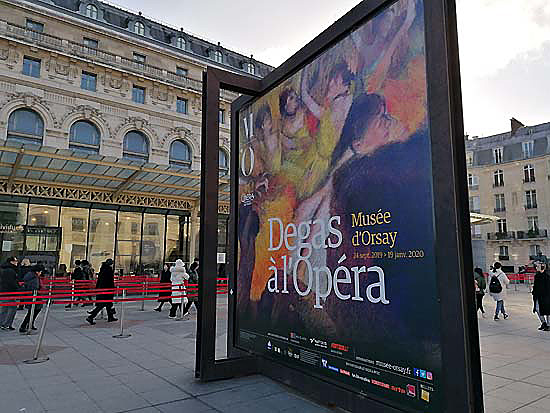

    Shown at the exhibit Degas at the Opéra at the musée d'Orsay (2019)

Their interludes are the link 
 between court dance and cabaret floor shows, 
which also began in Paris.

 *     *     *


Wednesday, October 25, 2017

MILLIONAIRES AND BALLERINAS


"KEEPING" A DANCER WAS A SOURCE OF IDENTITY, PRESTIGE AND CREDIT

 "Mr. Leuwen, the wealthy banker who keeps Mademoiselle des Brins, of the Opéra..."
-- Lucien Leuwen by Stendhal, 1834

# # #

The second act over, the subscribers would meet the dancers backstage or in a room specially designed for that purpose, whose idealized image contributed to Paris's reputation for high-end sex:

 Backstage at the Opéra by Jean Béraud, 1889, Musée Carnavalet 

     The Foyer de la Danse, courtesy Opéra archives
"It is meant [...] as a setting for the graceful groups of ballerinas [...] one thinks of a kaleidoscope when they intermingle in thousands upon thousands of ways."
 -- Charles Garnier

As seen by Degas:


        Shown in the exhibit Degas à l'Opéra on the centenary of his death, in 2017.


Those ballerinas, "the elite of Parisian pleasures:"

  • "Her mother, as I have since learned, to my horror, was a dancer at the Opéra."

-- Said of the adventuress Becky Sharp in Vanity Fair by W.M. Thackeray 1848.

      Degas monotype, origin unknown

  • The expression C'est ma danseuse  ("It's my dancer") means a pastime that absorbs huge resources and gives nothing in return. It harks back to the dancers' exorbitant demands for presents.
.
From humble backgrounds, usually illiterate, they left no records, and we know of them only through men who despised them.

They despised them back. The black choker Degas's dancer wears recalled a dog collar and meant, "We know what you think of us. We don't like you either."  

-- Nadège Maruta, cancan choreographer and historian,
personal communication

  • Dancers' and courtisans' revenge : "At every bite, Nana devoured an acre...

She passed [...] like a cloud of locusts [...] she burned the land where she placed her little foot. Farm by farm, prairie by prairie, she bit into the inheritance [...] without even noticing, as she would munch a packet of pralines [...] but one night, all that was left was a little wood. She swallowed it with a look of contempt, for it was not even worth opening her mouth."
-- Nana by Émile Zola, 1880.
# # #

The practice declined 
when the "Opéra girls" joined a strike of Opéra employees and obtained livable salaries: Abonnés' furious letters show that many then refused their "sponsorship." 
(In 1912)

It ended when the austère Protestant Jacques Rouché became director and ended their privileges by financing performances himself.
(In the 1930's)
-- Pascal Payen-Appenzeller, historian of Paris,
personal communication.

When Rouché's funds ran out the State took over.
(In 1939)
 
*     *     *

Tuesday, October 24, 2017

DEGAS'S "LITTLE DANCER"


BALLERINAS WENT ON STAGE AGED 13 OR 14, HAVING TRAINED SINCE THEY WERE SIX OR SEVEN: SO THE DEBAUCHERY OF A BALZAC HEROINE BEGINS
(CORALIE IN SPLENDOR AND MISERY OF COURTESANS) 

Their scampering recalled that of rats and they were called "petits rats."

By Degas 
Notice the man on the left and the exchange of glances.

Pedophilia, publicly tolerated

At Palais-Royal, Internet, no further information

"Little dancer, 14 years old:" For Degas, the low forehead and salient jaw were monkey-like signs of degeneration and criminality:

"The vicious muzzle of this young, scarcely adolescent girl, this little flower of the gutter, imprints her face with the detestable promise of every vice."
-- Critic cited in The Painted Girls
 by Cathy Marie Buchanan, 2013, a novel about the model based on fact.

Communards say:
"If you do not want your daughters 
to be instruments of pleasure
 for the aristocracy of wealth, 
workers arise!"

-- Paris Babylon by Rupert Christiansen, 1994

*     *     *


A CEILING DECORATED BY AN ORGY


NYMPHS SEDUCE SATYRS AS BACCHUS* LOOKS ON, IN DECOR THAT COVERS THE FULL CEILING OF THE ABONNÉS' SALON
-- The Fête of Bacchus by Georges Clairin

*God of debauchery


End of this section.

*      *      *  

Next section,
II.7.3.
Blackout?