Monday, August 31, 2015

5.6. FEAR, UNLIKELY PROMOTER OF URBAN GRANDEUR


MENU: 5.6. FEAR & URBAN GRANDEUR

AN OFFICIAL'S WIFE "TREMBLED EXTREMELY, FOR SHE HAD JUST HEARD, ON AN ORGAN, A POLKA THAT WAS AN INSURGENT'S SIGNAL"
-- L' Éducation sentimentale ( "Sentimental Education") by Gustave Stendhal, 1869

June's unprecedented working-class insurrection terrorized the privileged. It explains the arrival of the exceptionally autocratic Second Empire (1851-1870), which transformed the city in a way that made crushing future insurrection easier.

  • The changes began in June 1853, when the Emperor replaced a timid administrator with the dynamic Baron Haussmann. He forced financing, planned arteries and determined compensation for properties to demolish.


  • From 1853 to 1869 Parisians put up with noise, dust and rubble and corruption. 


The Baron Haussmann and Émile Zola's novel The Kill (1871) ("la curée" is the remains of a hunted animal given to the dogs): "Aristide Rougon swept down on Paris, on the day after December 2 with the flair of birds of prey that smell battlefields from afar."


*      *

Historians emphasize modernization, which in the still medieval town was inevitable. They mention the military aspect as one factor among others, or not at all.*

*Studies that do alude to it: Paris, Bivouac of Revolutions by Robert Tombs (1999) and The Invention of Paris by Éric Hazan (2001). But Tombs mentions it only in passing (p.56) and Hazan does not call it overriding. 

The next pages show the priority
of repressing insurrection.

Saturday, August 29, 2015

5.7.1. "AN OUNCE OF PREVENTION:" CHURCHES AND A PARK


"ONE CAN DO ANYTHING WITH BAYONETS EXCEPT SIT DOWN ON THEM," SAYS NAPOLEON III 

So he promotes a faith that teaches the poor "useful resignation to the conditions of society" by...
-- Citation:  Adolphe Thiers in Valence, Thiers
  •  Building churches:

Notre-Dame de la Gare in the poverty-stricken 13th (1847-59)
 
 Saint-Bernard de la Chapelle in the industrializing northeast (1858-61)

  • Making public schools teach the catechism:
The "Falloux law" (passed a year before Napoleon III took power), was named after the arch-conservative Count de Falloux, who had led the opposition to the National Workshops.

  • Promoting charity that condescends to recipients and honors sponsors:

Painting in an antique dealer's window

Society women have "their own" poor and give few alms after mass, so as not to compete for "clients."
-- Jean Renoir, My Father

"To be a good benefactress
Ladies, knit everything in the color of goose-droppings
so that at mass on Sundays
You can recognize your poor."
-- Song by Jacques Brel, Youtube
Written in 1960 to mock a mentality that had not changed
(Brel emphasizes the last words when he sings himself).
Results:

  • Paris becomes a capital of neo-Gothic architecture.

  • Visceral anti-clericalism, as shown by the cancan step "cathedral:"

     Performance by Nadège Maruta, cancan historian and choreographer / photo Félix Sinpraseuth
The bloomers were pierced. For the transgressive context, please click and scroll down.

More reasons for that hostility

  • Nuns' low prices for sewing reduce those of seamstresses.

  • Registering babies born out of wedlock costs two days' pay (a fourth of working-class couples live in common-law unions). 

*      *

"The Socialist emperor"* does do something for the poor: he creates a superb park in the working-class east.
(The Buttes-Chaumont, in 1867)

*Napoleon III had written The Extinction of Poverty and genuinely wished to help workers... without hampering employers.  

 Internet, source not said
                                                                                                                                                                    Vito

Those palliatives do not change
working conditions and salaries:
Elites foresee another insurrection.

*     *     * 
            

Friday, August 28, 2015

5.7.2. OPEN THE TOWN TO THE ARMY


AN ARTERY LETS TROOPS RUSHED FROM THE FRONTIERS CUT THROUGH TOWN, WITHOUT SMALL STREETS' OBSTRUCTION

As well: "These grand strategic arteries will push back the workers  [...] and also help contain them."
--  Baron Haussmann,
 cited in The Atlas of Haussmannien Paris by Pierre Pinon, 2002, p. 93

The wide, straight street lets troops move quickly from the Eastern Station to the heart of town. The Northern Station is a few steps away. 

Adapted from a Google aerial map 
 La rue du Chat qui Pêche, 5th (between Notre-Dame and Saint-Michel)
A medieval street that survived 

*      *

Demolition covered the entire territory east of rue Saint-Denis, where the June barricades clustered:

 Adapted from a document at the National Library / zoom
Avoiding workers' presence explains why Parisian railway stations are on the outskirts, in contrast to London and New York.* 

*Except the former Gare d'Orsay, built in 1898 across the river from the Louvre, when strikes had replaced revolts.

"In that way the workers were pushed back toward the outskirts; and as one easily understands, that change influenced in a positive way order and public safety." 
-- Général Moltke visiting Paris, cited in Atlas du Paris haussmannien, p. 93


*     *

Those demolitions explain the rarity of medieval remains, the dreariness of much of the center and the rebuilding of the former working-class quarters in the homogeneous style adapted to the new bourgeoisie. 

The Etienne Marcel crossroad

            Photographer not named
1 boulevard Poissonnière, 9th district

*      *

The metamorphosis continues until at least 1925... 

Piercing the boulevard Haussmann in 1925 / zoom

But most is done in the 15 years 
that follow the insurrection of June 1848. 

*    *    *
 

Thursday, August 27, 2015

5.7.3. THE CENTER'S GIANT VOIDS


THE ARTERY IS PART OF A NETWORK THAT LINKS THREE VOIDS, LARGE ENOUGH TO RALLY TROOPS, HORSES AND CANNONS 
(AMONG THE FIRST TRANSFORMATIONS, IN 1852-1853)

Those huge spaces of central Paris are place Saint-Michel and the esplanades of Notre-Dame Cathedral and City Hall:

Adapted from a Google map

*     *

The artery crosses the river by a new bridge to the left bank, where soldiers can assemble at hugely enlarged place Saint-Michel:
Web photo, photographer unknown

            Walls of Medieval Paris Discovered during Demolitions for Place Saint-Michel, engraving 1860 / zoom
     "N:" pont [bridge] Napoleon III; after his downfall, pont National


There the army could stay to confront residents of the turbulent Latin Quarter, take the prolonged artery toward the equally tumultuous working-class south or march along another widened street to the parvis of Notre-Dame Cathedral:

  
Boulevard Saint-Michel toward the south

                                          View from a tower of Notre-Dame  

At Notre-Dame they could take yet another enlarged street and a reinforced bridge to the third greatly enlarged space, the esplanade of City Hall:

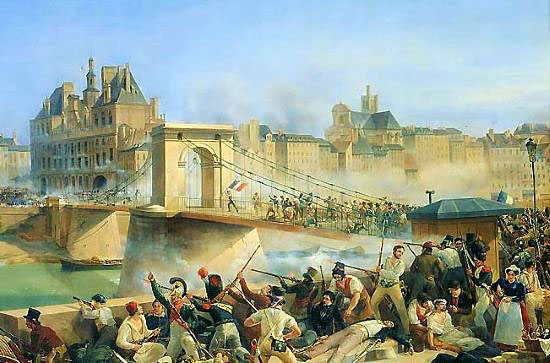
  Taking City Hall (cropped) by Amédée Bourgeois, 1831 / zoom


The bridge before and after transformation

Model at the musée Carnavalet
Drawing based on archival records / zoom
The space in front of City Hall in 1830 and 1855 

*      * 


That void was part of another network, built to march troops through the right bank: 


Adapted from an AI map

The trade route (rue Saint-Antoine) that Louis XIV took for his cortège had been widened in the 16th century for tournaments. 


To the right of that esplanade is an insignificant street for ordinary traffic, as at Notre-Dame. It leads to another wide, straight street (avenue Victoria) from which the army could reach the center of the right bank, Châtelet, five minutes away:


*     *

Behind that junction were the Lobau barracks. More later.

*     *

Such changes allowed more fluid circulation and let in light and air. But the three huge voids, two of which are dead ends, had no tie with those objectives. They were built for assembling soldiers, horses and cannons. 

The same is true for
the three giant spaces to the east:
More later.

*    *    *
  
Next,