Wednesday, August 22, 2018

II.5.5. THE CHURCH OMITS PAGAN DECOR...


BUT USES ANTIQUITY IN ANOTHER WAY

Compare these paintings of the 11th-and 16th-centuries:

  • Medieval shepherds wear laborers' clothes and seem to be ordinary men.

Manuscript, 14th-15th centuries, zoom

Book of hours of Etienne Chevalier, toward 1460 / zoom

     By Robert Campan, toward 1420 / zoom

  • Their descendants have the bodies of gods and may wear antique draperies. 

By Pellegrino Tibaldi, 1548 / zoom

By Perin del Vaga, 1534 / zoom
  
The gold of sacrality yields to a Roman arc. 
 
By Luigi Benfatto, end 16th century / zoom 

*     *     * 
Next,

RUBENS'S DECOR FOR A QUEEN


THE LOUVRE DEVOTES AN ENTIRE ROOM TO THE MOST EXUBERANT PROPAGANDA EVER IMAGINED

Marie de Medici returns to power* and as a true Medici, hires the time's leading painter to present her life as she wants it told.

*In 1621-1630. For the start of her story, please click.

The first modern biography is also the most famous use of allegory, with the 24 life-size paintings Rubens creates for her palace in 1624-1626.

Most visitors head to the publicized works, so you will have the huge room almost to yourself. 

       La Régente militante. La Victoire à Julich / zoom
 A white horse, symbol of royalty
How Marie might be remembered had she not lost her temper... .

# # #

Background: the conflict between Marie and her son Louis XIII, who at age 15 takes power through an assassination (for that story, please click on the link above).

  • Louis XIII, the teen-age prince. In 24 paintings he appears only seven times, and never in a commanding way. Marie wants to keep on ruling: 

         La Remise [Consignment] de la Régence à la Reine / zoom
Marie dominates. As he grows older Louis pretends to be retarded and almost all the courtiers ignore him. They regret that mistake for the rest of their lives, which might be short.

  • The 14-year-old French and Spanish princesses, exchanged at the border

      L'Échange des princessezoom 
 The girl in white is Anne, Louis's bride.

If your little girl dreams of being a princess and marrying a prince, tell her she would never see her family again. Plus, as a foreign princess the court might think she was a spy (as Anne really was). 

A queen's sole path to influence: becoming regent should the king die and leave a son too young to rule. That was how both Marie and Anne came to exert Europe's most important regencies. 

  • Dogs fill empty space 

   Le Couronnement de Marie de Medici à Saint-Denis le 13 mai , 1610 / zoom

  • Monsters: Marie's enemies, neutralized or defeated

             Louis XIII atteint sa majorité [comes of age]zoom                             La Reine réconcilie avec son fils zoom

Left out: the servant Leonora, the hustler Concini, Marie's banishment and imprisonment... (click if you haven't yet).

        L'Expulsion de Paris / zoom
The rejected sketch for the work on her disgrace.


The series is important for itself, for its influence...

  • David studied The Coronation of Marie de Medici, shown above, before beginning his most famous work:

La Consecration de l'Emperor Napoléon I et le couronnement de l'Impératrice Josephine à la cathédrale de Notre-Dame le 2 décembre, 1804 by Jacques-Louis David / zoom


        La Mort de Sardanapolus by Eugène Delacroix, 1827 / zoom


...and for showing omissions
to the wished-for point of view.

*     *     *

Next,


Tuesday, August 21, 2018

A PLEA FOR PEACE AND A THREAT OF REVOLT


NOBLES' ART GLORIFIES WAR, BUT MARIE HAS RUBENS INSIST ON PEACE...

A caduceus (two serpents coiled around a baton) symbolizes the accord of opposites, so wisdom and harmony. In paintings where every detail is politically charged Rubens associates it with Marie alone.


-- Heroic Deeds and Mystic Figures by R.F. Miflin and R.E. Wolf, 1989,
analyzes the series in depth.

In the first work Mercury points the caduceus toward the line that joins the right hands of Apollo, Minerva and Marie with the abdomens of the Three Graces: Marie unites wisdom, culture and fertility, characteristics that fit her ardent opposition to Richelieu's demand for war.

     The Education of the Princess / zoom

One of the next paintings evokes the choice of entering or staying out of the Thirty Years' War (of 1618-1648):

The Meeting in Lyons / zoom 

  • Louis carries his scepter like a musket and turns away from his mother, while his charming little brother, Gaston d'Orleanslooks up at her adoringly. Junior princes who led revolts legitimized them and when this work was painted, in 1626, Gaston had rebelled. The scene implies that should Louis refuse Marie's demand for peace, she might back him should he revolt again. (He would do so four more times.) 

 
  • The intrepid queen had already escaped imprisonment and led two rebellions. So this was not an empty threat.

The king studied the paintings, had them explained to him and left without a word. They may have contributed to Marie's fall, but the main reason was an immense mistake... more here

End of this section.

*     *     *

Wednesday, August 15, 2018

2.5.6. DETOUR: HISTORY — ANECDOTES OR THE ECONOMY?


 A TANTRUM CHANGES THE COURSE OF HISTORY... FOR AWHILE 

Will Louis help the poor with peace and tax reform, or grind them down still further with higher taxes due to war?  

Marie loses her temper against Prime Minister Richelieu in the king's presence. That disrespect brings the crisis called the "Day of Dupes," and Louis's choice for Richelieu and war.
(November 10-11, 1630)
  Basic account:
The Recollections of the Duke of Saint-Simon, who was present immediately after the event, 
as told his son (the memoirist).
Presented with comments by Georges Mongrédian,
La Journée des Dupes, 1961


A hagiography

Bishop of a destitute commune of western France (Luçon), Richelieu believed that to make the poor work they must be treated like mules. He also confirmed Louis XIII's authoritarianism and helped found the centralized French State. Conservative historians admire him. 
 
# # #

  • Richelieu comes to power by helping Marie return to favor after her fall, then takes her place as the king's main counselor. She hates him for that betrayal* and for his policies of violence.

*A subordinate's loyalty was considered automatic and the difference in rank made him her servant.

  • She arranges a meeting with Louis to have him disgraced but leaves a door unlocked, and he suddenly appears. Stupefied, she insults him in a way that is "unimaginable," "out of the gutter"...

   Maurice Leloir

Richelieu throws himself at her feet...

kisses the hem of her robe, bursts into tears and begs the king to let him return to his lands. When Louis says nothing, he leaves. A few minutes later the king passes before him and meets his bow with glacial silence. Fearing arrest and execution, recalling Concini's mutilated corpse and the rapidity with which one's fate can change, he prepares to flee.

At home, Louis "threw himself on his bed and tore off his doublet so furiously that the buttons flew off." But after reflection at his hunting lodge at Versailles, he sends for Richelieu to join him. Shocked by Marie's disrespect for monarchy shown by her language in his presence, he makes a decision that is almost unimaginable then, of choosing an underling over the queen of France, widow of Henri IV and mother of the Duchess of Savoy and queens of Spain and England. As well, though deeply religious he transgresses the commandment "Honor thy father and thy mother," an act for which he will feel remorse for the rest of his life.

Certain that she has won the showdown, Marie appoints Michel de Marillac,* the head of the Catholic pro-peace faction, Prime Minister. But the resurrected Richelieu has him arrested; he will die in prison. He also has Marillac's brother, the Captain of the Royal Guard, decapitated on a trumped-up charge, to send adversaries the message that opposing him will affect their families too.

*Uncle of Saint Louise de Marillac. For more about her and the impressive Catholics of the time, please click.

# # #

Marie remains Richelieu's implacable opponent, and helps Gaston foment the revolts that follow. She dies in exile (in 1642) almost without resources, saying that her only regret is forgetting to bolt a door.

  • Misogyny and nationalism lead to dismissing her as "without grace, heavy, with eyes that were round and inexpressive, brutal gestures and incurable vulgarity [...] silly, proud, short-tempered, opinionated, lazy."
-- Richelieu by Philippe Erlanger, 1996, p.77. 
More objective but still negative:
Marie de Médicis by Philippe Delorme, 1998, and
Les Reines de  Queens sous les Bourbons by Simone Bertière, 2003
  • She can also be seen as feisty and determined, and above all be respected for trying to maintain peace.  

# # #

With her fall, France lurches into the Thirty Years' War:

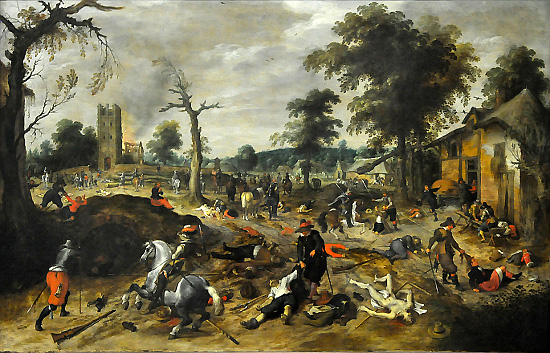
  • Central Europe loses a third of its population and Burgundy, Lorraine and Picardy are devastated. Fifty years later Protestants fleeing France find a welcome from German princes wishing to replace slaughtered populations.

   The Pillaging of Wommelgen by Sebastian Vranx, 1625-30 / zoom

  • Most of the kingdom is spared fighting on its soil, but taxes and requisitions bring revolt and repression:

     Les Misères de la guerre : pendaisons [hangings] by Jacques Callot, 1632-1633 / zoom

This war of twists, turns, countries and factions is hard to follow. Jacques Callot's etchings, Les Grandes Misères de la guerre [war], state the essential (for the 16 etchings, please click and scroll down). 

# # #

The "Day of Dupes" is considered one of  "The days that made France " ...*

* Title of the series in which the study mentioned at the top of the page.


Because, it is said, bringing the country into that struggle kept Spain from dismembering or conquering it

But in the 1630's...

  • Spain had 8 240 000 residents, France 20 000 000 (please click).
  • Spain's economy was archaic, France's one of emerging capitalism.

A Spanish victory was impossible
and French hegemony in the long run inevitable.  


# # #

Children can play the scene, thinking up insults ("Your socks stink!"They'll roll around laughing and love history.

They can question that anecdotal approach later. 

End of this section.

*      *      *

Next section,


Saturday, July 14, 2018

II.6. THE GODS' MODERNITY

MENU: 2.6.  THE GODS' MODERNITY

GODS AND ESPECIALLY GODDESSES, SYMBOLS STILL


Iconic works and deities
that monuments and parvenus still copy.


This visit begins with a suggestion for families: For that introduction and for finding the iconic works in the huge museum, please click here.