THEY PROMOTED A CULTURE THAT APPRECIATES WOMEN
-- Background:
Les Femmes du Roi-Soleil by Simone Bertière, 1998;
Francois I (1525-1547) wanted his court to reflect his growing authority, but nobles stayed in their castles, drank and brawled.
François I by Jean Clouet, toward 1530 / zoom
So he extended a practice of the previous reign, inviting nobles' daughters to the court. He lent the 300 young ladies sumptuous clothes and jewels and had them educated by the queen, hoping that they would attract and civilize the men.
- They did. Friendships among themselves led to a subterranean network by which male members of their clans obtained or passed information, understood what they might seek without risking refusal and might intrigue rather than revolt.
-- Reines et favorites by Benedetta Craveri, 2005, p.46.
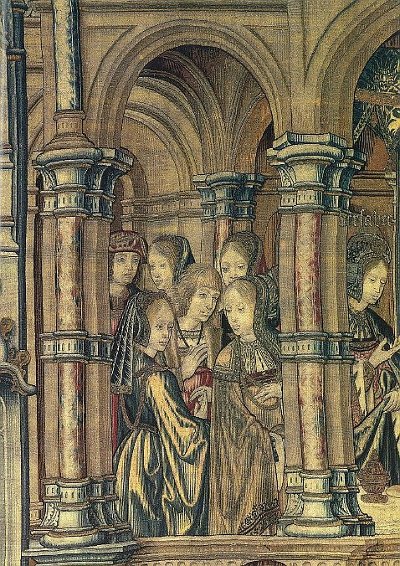
- The 16th-century court is still known for its refinement.
 |
| Tapestry, publication of the Renaissance Museum |
"Ball at the court of the Valois, SOLD OUT:" event at the musée des Armées
The Generals' Feast, tapestry of the Renaissance Museum, 1535 /
zoom
When Henri IV, founder of the Bourbon dynasty and of stronger monarchy, came to power in the late 16th century the crassness of the court shocked his Florentine wife, Marie de Medici.
A novelist captures her disgust with this imagined response: "There was a brute in each of the men, a prostitute in each of the women. Certain expressions, certain jokes made me close my eyes in confusion, even sometimes cover my ears with both hands.
-- La Galigaï by Eva de Castro, 1987, p.198
- Henri as Rubens portrayed him:
"Henri IV holds himself badly!" my eight-year-old cried out on seeing this work.
The best military leader of his day, he spent 40 years in army camps. He never took a bath, rarely shaved and thought that stinking marked a viril gentleman accustomed to combat, far superior to the well-turned-out but tame bourgeois.
When dining with the queen, he would spatter soup on her ruff. "Sorry, darling," he'd say, and spatter her again. Yet his love letters to his girlfriends — he is said to have fathered 53 bastards — are masterpieces of style.
* *
Transformation came from salons where noblewomen met for refined conversation. There they invented the "Map of Love, which advised gentlemen that to reach the "Dangerous Sea" of passion they must advance from village to village, that is, step by step:
That code encouraged urbanity, self-control and hierarchy, traits that the monarchy would take to extremes.
* *
Queens' and favorites' complimentary roles:
- Queens' function was to give children to France. As well, by participating in ceremonies, visiting churches and giving alms, they seemed closer to the people than the king and humanized the monarchy.
The young women who surrounded them set the tone. But the queens themselves, as foreigners chosen for political reasons who might never speak French well or grasp the court's complicated ways, usually remained in the background.
- Three emerge from insignificance, as regents when kings died leaving sons to young to rule or by maintaining their influence over them.
Those anomalies:
 |
Catherine de Medici, regent then queen mother, 1559-1580's / zoom
|
"Nobody likes their husband's whore," Catherine wrote, showing how queens were obliged to accept the favorites described below. Such servitude taught Catherine the observation and duplicity for which she is infamous. "I never believed you ate little children," the queen of Navarre wrote to her.
But "A major opponent and the final victor, Henri IV, called her 'a great king' ." ».
-- A positive biography:
Sur Catherine de Médicis, introduction by Balzac of his historical novel,1830-1846
Stout, with globular eyes, dressed in widow's black, she was interested in power, not elegance. But the 80 girls who encircled her to seduce and spy maintained the glamour of the court.
|
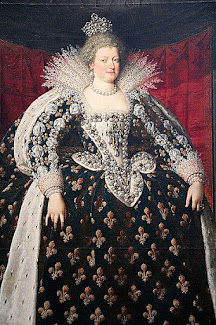
Marie de Médici, regent 1600-1616 / zoom |
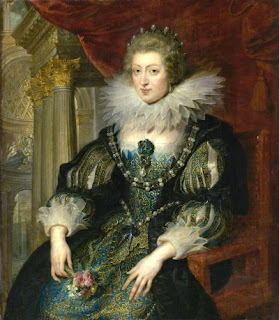 |
| Anne of Austria, regent and queen mother, 1643-1666 / zoom. |
Marie de Medici was as power-hungry. For her story, please click here and here. Charming, sociable Anne of Austria left politics to a brilliant Prime Minister while expertly running the court.
- Favorites: Official royal mistresses. Beautiful, cultivated and elegant, they gave the court its éclat.
Diane de Poitiers, the power behind Henry II, upstaged Catherine de Medici for 20 years. The marquise de Montespan contributed to the court's prestige during Louis XIV's most glorious time (roughly 1670-1685). Her link with a serial-killing witch brought her fall.
The Marquise de Pompadour influenced culture brilliantly and foreign policy disastrously. The Countess du Barry is best known for crying, "Give me one more minute to live!" before she was guillotined.
Royal mistresses were necessary. They led nobles to remain at the stifling and expensive court, since if the favorite were of their clan she would distribute among them the king's largesse and if she were not, to intrigue to replace her. As well, their extravagance made them lightning rods that drew popular fury away from the king.
-- Les Femmes du Roi-Soleil by Simone Bertière, 1998
The institution evolved in the 18th century. The rising middle class had a stricter morality, and neither Pompadour nor Barry were nobles (the latter had even been an escort). Yet during the Restauration, courtiers were delighted when the aged king granted a confidante a mansion, seeing it a return to favorites and so to the Old Regime.
- Marie-Antoinette's spending and elegance meant acting like a favorite, behavior that led to her fate:
* *
The court, the salons and the twin roles of favorites and queens explain women's influence on French culture.
They encouraged the arts,
demanded a courteous relationship between the genders
and turned luxury into taste.
* * *
Next,


%20new%20arrow.png)

.JPG)

.png)


