Monday, January 19, 2015

CORRECT THE ERRORS, BUTTRESS THE ADS


SOCIAL FORCES ARE ABSENT AND A LONE INDIVIDUAL REPLACES THE MASSES  

French school programs follow a national model. These textbook covers of 2025 differ, but the point of view is the same: 

Top-hatted men behind the well-dressed woman underscore the privileged and dominate the figure with the cap. The soldiers in the trenches of World War I are classless and isolated. A woman's face indicates an individual story. An industrial scene shows chimneys, not a strike.  

     Isolated figures
 
# # #

La Commune, a civil war with no social content: 


The Paris Commune:
A civil war (1871)

Legislative elections bring monarchists to power, who choose Adolphe Thiers as head of the government. Thiers allows the German army to have a march of triumph in Parischooses Versailles as the new capital and stops paying the National Guard. He is ready to sign peace with Germany.

Absent:
  • Ending the moratorium on paying rents, reimbursing debt and pawnbroker sales: disastrous for the poor when unemployment remains high.
  • Transferring the government to Versailles means that businesses on the verge of bankruptcy lose a clientele of over 600 deputies, their families and servants. 

# # #

Parisian determination to pursue the war with Prussia:


In contrast to the provinces, Paris voted massively of republican candidates and for the pursuit of the war and oppose Thiers. Most battalions of the garde refuse to accept the authority of Versailles.

Absent:
  • The incompetence of many generals and the widespread suspicion of their treason.
  • The suicidal Buzenval attack.
  • The shooting of January 23.
  • The belief that Versailles preferred peace with the Prussians to accepting Parisian social demands.

# # #

The conflict


Picture of Louise Michel: more below.

On March 18 1871, the drama explodes. Thiers orders the National Guard to take hold of the cannons on the Montmartre hillside. Furious, the Parisians oppose that, as does Louise Michel. Thiers orders his troops to leave the town, to besiege it. The whole city revolts and representatives of the Commune of Paris who adopt the red flag in replacement of the tricolor.

# # #

La Commune: one sentence, and transformative measures left out

[Paris wants to] be free, govern itself, invent a new society: separate Church and State, secularize schools, liberate the press, open museums to the public.

Omitted:

  • That these changes inevitable with industrialization, the free museums excepted. The Republic adopts them a decade later.
  •  La Commune's transformative measures: Women's cooperatives, worker-run enterprises whose owners had left, public establishments run by employees (decree in prĂ©paration).

# # #
 
Violence: acknowledge that of the army*...

*Obligatory, given the appellation "Bloody Week:"

Wishing to get it over with,* Versaillais troops enter Paris [and engage in a violence] without limits during Bloody Week (May 21-28 1871), leading to at least 10,000 dead. Judicial sessions succeed military repression with condemnations to death, to prison or else  — as for Louise Michel — to New-Caledonia (see chapter 8 p. 240).

 *A suggestion that the unprecedented ferocity was rational.

Omitted:

...and put the six executions by a single Communard fanatic on par with it:  

"The Communards too plunge into a revolutionary logic of violence [what?] , with the execution of several hostages." 

How can "several" compare with "at least 10,000?" The writer does not care enough to think through his (or her) account. 


# # #

A single figure, Louise Michel, replaces all the Communards: 

Left, her arrest. Right, the fires associated with La Commune, with no mention of the army's equal responsibility.


Alternative: 

Zoom (please scroll down) 
  "Construction workers' homage to our elders who died for la Commune."
Louise Michel (shown on the banner to the left) is one of many Communards.  

Underscoring a single actor enlivens an account...

  
...that divorced from concrete interests is incomprehensible and reinforces the chimerical individualism that huge companies use ads to promote.


Corner of rues de Tolbiac and Nationale, 13th

For how all aspects of a culture
reinforce the elites
please click here for Old Regime France
and here for us.

*     *     *
Next, 


Sunday, January 18, 2015

THE CARNAVALET BEFORE RENOVATION (in 2016-2022)...


IN 2010 THIS EYE-LEVEL PLAQUE WAS INSTANTLY VISIBLE
 
In 2016 it had been moved to a dark corner near the floor and I had to search to find it... 

"The fights that marked the end of the Commune were extremely violent, the Versailles troops shooting without judgement all the subjects they arrested. General Mac-Mahon, chief of operations, admitted 17,000 executions, a number that should doubtless be raised."

La Commune occupied two minuscule rooms at the back of the third floor. The first room...

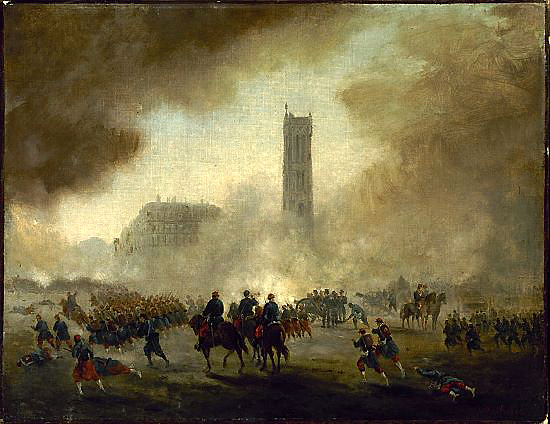
  • Showed four paintings of fires associated with Communards.... 

The Fires of 1871 by Gustave Boulanger, 1871 / zoom

Zoom

     Zoom

Zoom
As with earlier combat scenes, violence merged into the city scape. There was no reference to destruction by the army.  

  • ...and one work from a Communard perspective:

  Execution of a Drummer Boy during the Commune by Alfred Roll / zoom

# # #

The second room was sunlit, 
and devoted to portraits 
of Versaillais generals or government leaders.

*     *     *

Next,


Saturday, January 17, 2015

...AND AFTER IT


LA COMMUNE NOW OCCUPIES A FOUR-METER PASSAGE, WEDGED BETWEEN SPACES ABOUT ELITES 


The first space is devoted to the Baron Haussmann...


The second to the privileged of 1900: 


# # #

La Commune is inserted in the short corridor between them. At its start a small picture of washerwomen. It is a rare work in the museum to show working-class people, but has no connection with what is supposed to be the topic. 

Next to it is an account with the same bias as that of the textbook just described. As well, the letters are so small that the account is hard to read.  


The 72 days of the Commune of Paris
(March 18 - May 28 1871)

The defeat leaves France divided. The decapitalization of Paris in March is rejected by the Parisian population. [No mention of social measures.] The national guards create a republican federation (hence the name "fĂ©dĂ©rĂ©s") and regroup on the heights of Montmartre and Belleville. [And throughout the underclass east, north and south]. Adolf Thiers, head of the executive power, orders that 277 cannons [no, 177: an error that reveals the writer's ignorance, as here and hereof Montmartre be taken back, but his troops retreat to Versailles. The political leader and writer Jules Vallès writes, "Paris is reconquered." [An individual replaces the humble population.] On March 26 a general council is elected, in homage to the insurrectional commune of 1792-1794. It is the first experience of communal self-government in [untrue for Paris and for a number of European citiesrevolutionary history. The Commune is proclaimed on March 28. A number of measures are adopted (separation of Church and State, recognition of concubinage, election of officials and judges, citizens' control of officials, education of girls... ) [Skips measures that contest the social hierarchy]. But on May 21 mai, Thiers's army invades south-western Paris. The Communards set fire to a number of public buildings on May 23 and 24 [Nothing on army destructions]. 7000 - 10,000 people [a number that is much too low] die during Bloody Week (May 21-28 1871), which marks the end of the Commune.

  • Then comes a work about communicating by balloon during the siege of Paris, a service whose cost reserved it to the wealthy. It eats into a large part of La Commune's minuscule space.


In the area that remains:

  • On one side of the passage, figures who were secondary at best:

The balloon painting on the left takes up part of the passage.

From left to right

  • Auguste Blanqui. As a prisoner of Versailles he played no role in La Commune.
  • Louise Michelobligatory now but little known then.

On the other side of the passage

  • The announcements that stand out by their large black letters mean nothing to the spectator. The arrow points to a reflection of the Rochefort bust. 


  • Under the proclamations are two small images of carnage: That behind the arrow is almost invisible and the firing squad is hard to see.  
The museum renews the exhibit by replacing these with other images of army violence, which are as small and as difficult to decipher.

Around the corner is emphasis on the burning of the Tuileries and City Hall... 


The objects in the niche above the picture of ruined City Hall concern its past to emphasize its loss. 

...but nothing about destruction by the army.

# # #

I happened to be present when a high school class arrived. The teacher mentioned Baron Haussmann and the Second Empire... 


...then walked through the passage without mentioning La Commune.


# # #

I asked young guards how to find that exhibit.
They did not know
and had never heard of La Commune.

*    *    *
Next,


Friday, January 16, 2015

THE MUSEUM OF A WORKING-CLASS BASTION BACKS DOWN


THE SAINT-DENIS CITY MUSEUM* DEVOTES ITS THIRD FLOOR TO LA COMMUNE, BUT ITS PRESENTATION HAS WEAKENED 
 
*This medieval town north of Paris is the site of the royal mausoleum. Industrialisation made it working class, Communist for a century (1921-2020), Social-Democratic now.  


On my first visit, toward 2015, a video clip on the mĂ©tro platform announced the exhibit. At the museum I watched it in full.  


When I returned in 2020, the video was gone from both metro and museum. I was told that there was an equipment problem that would take a long time to fix. In May 2025, it was still gone.

# # #

Strong points
  • Paintings of the time 

Marching Army by Alfred Rolls, 1871
The army plodding through the snow refers to the war with Prussia, but the scene is universal.

Anonymous
Communards continuing a killed comrade's aim fits the spirit of the sources.

  • Photos and caricatures  


Communards awaiting trial at Versailles. Bismarck and Thiers watch over a stew of Parisians that a demon cooks.

  • The point of view that Communards faced:
A Wedding during the Commune by FĂ©lix Guerie, no date
People without dignity

Left in the reserve:
  • Rich and poor after the repression 

Paris after the Commune by Frédéric Dix, no date

  • This photo

Blown up and seen figure by figure, the photos are even more poignant. But it has taken a high-school teacher, not the museum, to do so: Please click and scroll down.

  • The museum exhibits this modern adaptation.  

La Commune - cadavres de combattants par Arnulf Rainer, 1929 

The splash of color lessens the impact and disrespects these young, small and terribly vulnerable men. 
                                                                                                                  
# # #


The slant is the same as that of the textbooks, street panels and the musĂ©e Carnavalet.   

  • The exhibit of two almost interchangeable paintings when others are left out:

ExĂ©cution d'otages Ă  la prison de La Roquette 1871 Ă  8h du soir by T. Harreguy 

ArrĂªt d'un officier par la Garde nationale fĂ©dĂ©rĂ©e Ă  l'entrĂ©e de la Mairie [City Hall ] du 8e arrondissemen[district ] by Emmanuel MassĂ©, 1870

  • This write-up:


Emmanuel MassĂ©, portraitist and genre painter, here shows an officer of the Empire arrested at the 8th district city hall. Arrests were very frequent, as often by the Communards* as by the Versaillais who encircle Paris. The prisoners allowed pressure on the adverse camp and the summary executions nourished the insurgents' ardor in their desire for vengeance.*

*The real numbers: Hostages shot by a crowd, 51 Monsignor Darboy and five others; about 20 that a prison director refuses to shoot.

Mistakes
    • The subject cannot be an arrest by "the federated Guard" is impossible, since the painting is dated 1870 and the Guard was created on February 15, 1871. The arrest has to be by government police  the opposite of what's said.  
    • The write-up equates Communard and Versaillais arrests. In fact, the Communards took 74 prisoners, the Versaillais a countless number.

  • The information in the general descriptive panel could come out of a Versaillais account:


"Furious with the capitulating generals, the population improvises a tribunal that condemns them. That very evening, they are shot against a wall."

For that belief, please click.

Except for the works and documents of the time
we find the Versaillais slant,,
factual errors included.

End of this section.

*    *    *

Next,


Thursday, January 15, 2015

VI.3.3. TWO HISTORIANS FIGHT BACK

Menu: 6.3.3. Two historians fight back

BUT THEY ARE OUTSIDE THE ACADEMIC CIRCUIT

The late Michèle Audin was a university professor, but as a mathematician. Emmanuel Brandely is a high school teacher.

Discussion at a progressive bookstore on May 23 (2024), a date that calls up Bloody Week, May 22-28, (1871) next to a street where desperate fighting took place.

Bloody Week (2021)
Historians against the Commune (2024)

The time has come "to consider the human beings that were these cadavers with respect, to not let them disappear again — which means looking at who they were and what they did."

-- Michèle Audin, La Semaine sanglante, p.9.

*    *    *
 
Next,