
THE AUTOPOSY REPORT SHOWS THE GENERALS KILLED BY BULLETS SHOT FROM BEHIND...
-- L'Année terrible: La Commune, by Pierre Milza, 2014.
But even pro-Communard historians accept the Versaillais version of a firing squad, that is, of an insurrection sparked by premeditated murder.
Yet...
- Participants would have had to pose for such a photo, since the matériel of the time could not capture movement. So they pose in the midst of tumult?
- Versailles sponsored the montage. How can it be uncritically accepted?
- Soldiers have killed their officers spontaneously.* But by organized execution?
*As before the October Revolution and during the Vietnam War.

First of the series "The Crimes of the Commune," montages that Versailles commissioned from the royalist photographer Charles Edouard Appert. The next pages show others.
Yet only Victor Hugo found it "curious" that troops shoot their generals.
- Marx says conscripts' hostility to officers explains it. Yet these soldiers had no reason to oppose Clément, who as head of the Parisian National Guard was not linked to the army.
- The Soviet film The New Babylon skips it by having the Lecomte character tell the troops to abandon the cannons and return to Versailles. That is the exception mentioned earlier in a movie that otherwise follows the sources.


- Raspou'team, whose street art commemorated La Commune's 140th anniversary, accepts and even adds to it:


General Clément "who was already known for repressing the insurrection of 1848, is recognized while inspecting the barricades in civilian dress. Thomas and Lecomte are led to the rue des Rosiers, on the Montmartre hilltop. Both are shot. While about it, the National Guard parades under the windows." (The last sentence is imagination. Bolding mine.)
- A graphic novel has Louise Michel oppose it:
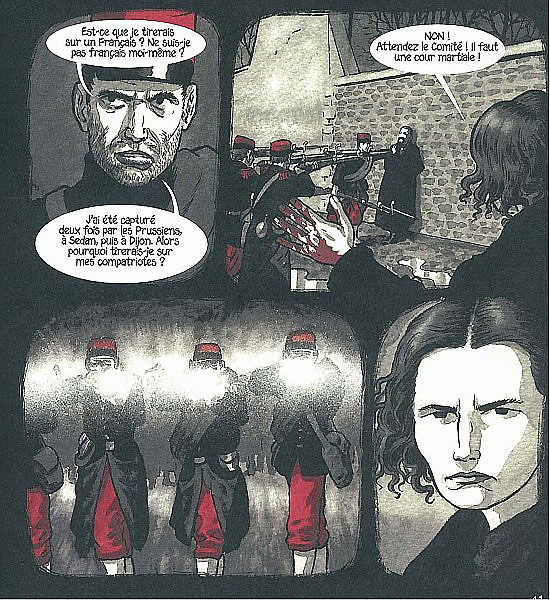
"No! Wait for the Committee! This needs a court martial!"
- A Bulgarian illustration captures the chaos, but keeps the firing squad:

Gone from the web
Execution of generals Thomas and Lecomte.
- A television series shows the crowd composing it, which erases mutiny but keeps premeditation.
-- Karambolage, "March 18, 1871" (in French)

- The 13th's historical journal* adopts it:
*Right-leaning but not deliberately biased.

La Commune de Paris,"Histoire et histories du 13e," n°7, June 2011
"General Lecomte is arrested then shot, rue des Rosiers, by his soldiers. General Clément Thomas suffers the same fate..."
* *
Louise Michel on Clément's arrest: "the guns went off on their own." Because of...
- Memories of June, the siege and its sufferings, the useless attempts to break it with their wounded and dead, the incompetence and suspected treason of generals, the shooting into a largely unarmed crowd, the launch of an attack that was sure to fail, the shameful capitulation, the firing of over 600 officers for "agitating noisily," the Prussian victory march without announcing the quid pro quo, the army's arrival by surprise when the cannons' return had been offered, the mortally-wounded guard.
- The effect of tolling bells and drum rolls.
- Residents coming from the bottom of the hill. The sense of personal responsibility is lost in a crowd: "It was as if my gun took over."
Then Lecomte refuses to have the wounded guard taken to the hospital, calls the furious residents "vermin" and orders his troops to fire on them — three times.
* *
Clément does not realize that having repressed the demonstration of May 1848, been decorated for his role in the June massacre and fired more than 600 officers for "agitating" means that "observing" in civilian clothes* is to stroll into the lions' den.
*In History of the 1848 Revolution Marie Agoult (Daniel Stern) mentions officers attired in that way observing the June barricades. So the practice must have been common knowledge, and remembered.
General Trochu imagines him "rushing to the scene as good soldiers go toward the fighting, believing, I am sure [...] that his notoriety as Commander of the National Guard and veteran of the republican cause would impress the hysterical crowds..."
By believing that "hysterical crowds" will listen to a killer of the people closest to them, he involuntarily reveals how deeply the privileged ignore their "dancing on corpses."
* *
Many historians simply follow what is usually said. As well, those on the left may not wish La Commune to have sprung out of such crime.
A version that makes more sense:
The outrage building for years
and especially since dawn,
and the myopia of the generals themselves.
* * *
Next,


No comments:
Post a Comment