
FRENCH TROOPS DELIBERATELY DEVASTATE PART OF WESTERN GERMANY, TO CREATE AN IMPASSABLE BORDER WITH FRANCE
(IN 1674 AND STILL MORE IN 1689)
* *
Heidelberg castle, as remembered in France:


L'Incendie du château de Heidelberg by Maurice Leloir in "Le Roy Soleil" by Gustave Toudouze, 1931


That laying waste should be carried out without hate or ideological fervor by relatively disciplined troops shocked more than at other times.
- Proof of deliberateness: Certain populations were given a week's notice to leave, and helped with wagons and supplies. Some became the ancestors of the Pennsylvania Dutch in the United States (article in French, note 11).
- Pillaging had always been a way to pay troops, and devastation reduced the adversaries' resources. During the Thirty Years' War (1618-1648) religious fanaticism had made things worse, but it was not a thought-out practice.
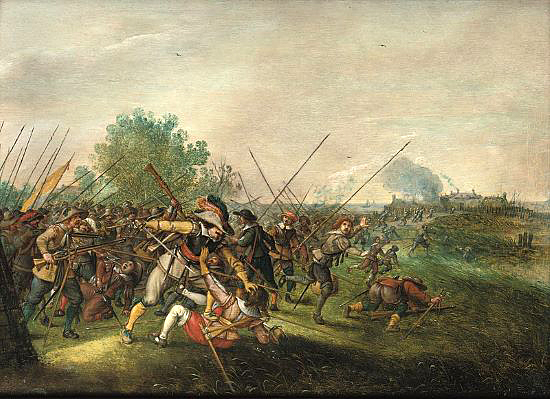
Combat d'infantrie avec un village en feu by Sebastian Vrancx (toward 1640) / zoom
- In the 18th century, that warfare was supposed to be limited is shown by the famous line, "Messieurs les Anglais, tirez les premiers" ("English gentlemen, shoot first"), though the English would be helpless as they recharged their muskets.

* *
Heidelberg castle, as remembered in Germany:
.jpg) |
| Heidelberg Castle by Gerrit Berckheyd, 1670, zoom |
- Anonymous pamphlet, 1693

"The Residence of the Prince-Electors, Lamentably Damaged and Abandoned by the Barbarous French: the Town of Heidelberg"
- German schoolbook, 1858

"The Destruction of Heidelberg by the French in 1689"
- It has never been repaired.

- "The French used to be thought honest, humaine, civil, of a spirit opposed to barbarism; but today neighbors think a French person and a cannibal are about the same."
-- Attributed to Pierre Jurieu, a Calvinist pastor: for a full account in French, please click
* *
Ripples:
- During the Franco-Prussian war (of 1870-1871) Prussian troops bombarded Paris with particular violence in the hours before the armistice, and Bismarck emphasized revenge by proclaiming the German Empire in Versailles's Hall of Mirrors, under a painting of victorious Louis XIV (please click and scroll down).
The Seven Years' War and Napoleon's invasion did not leave comparable memories.
- German annexation of Alsace and part of Lorraine was said to prevent another French invasion.
- The French wish to retake the "lost provinces" contributed to World War I.

Monument à Jeanne d'Arc by Emmanuel Frémiet, place des Pyramides |
- That led to the deliberately humiliating Treaty of Versailles and occupation of the Rhineland, acts that encouraged Hitler's rise to power.
- Germans were terrified of the French army re-entering the country in 1944, fearing a repetition of the 17th-century horrors.
* *
Imagine the effect of the arc when houses were lower:

- The power the arch proclaims was real for 15 years: "The great king of Christendom asserted his law as far as Sweden and Brandenburg. He ruled over the universe, less by force than by admiration. I loved him timidly."
-- L'Allée du roi, respected historical novel by Françoise Chandeneggor, 1981 (slightly changed)
- Then it brought an alliance that almost crushed the kingdom.
"On his deathbed Louis had the Dauphin approach and said,

Maurice Leloir in Le Roy Soleil
'My child, you will be a great king; do not imitate me [...] in the taste I had for war; try on the contrary, to have peace with your neighbors [...] and to relieve your subjects, which unfortunately I was not able to do.' "
-- Journal de la maladie du roi, "Louis XIV et sa cour par le duc de Saint-Simon,"
1994 ed, p. 259 (shortened)
* *
Advancing toward the arc
leads to pondering hubris,
on condition of knowing a story
that now is rarely told.
* * *
Next,


No comments:
Post a Comment