Thursday, January 22, 2015

"TO THE VICTORS BELONG THE SPOILS"


THE VERSAILLAIS CHIEFS ARE IMMORTALIZED AT TWO HUGELY PRESTIGIOUS SITES

Adolphe Thiers, says of the Communards "Those people, we get rid of them" and agrees to the carnage. Conservatives, even the monarchists, are reassured and accept the Third Republic. Thiers becomes President until his death (in 1877).

Portrait d'Adolphe Thiers by Léon Bonnat, 1877 / zoom
  • That cemetery was the site of the last combat. Regardless of Alphonse Daudet'story, bullet holes still mark the tombs and a number of illustrations record the fight:

L'Agonie de la Commune au Cimetière Père-Lachaise by Auguste Trichon after Charles Vernier, toward 1871 / zoom 
-- Musée Carnavalet, not exhibited

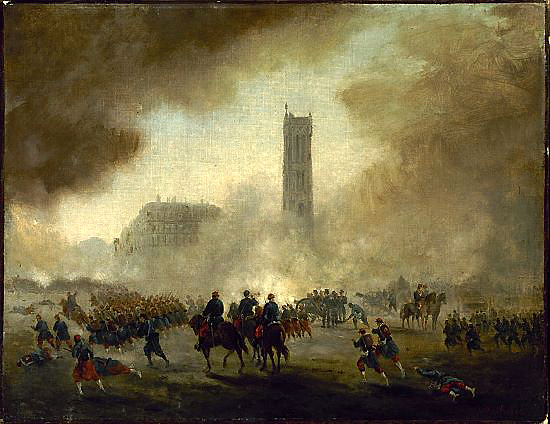
   La Commune brûle, le Père La Chaise, anonymous, toward 1871 / zoom  (please scroll down)

     Les Derniers Combats aux Père Lachaise by H.F.E. Philippoteaux, Musée d'art et d'histoire de Saint-Denis / zoom    

Raspou'team (please scroll down)

The Last Combat at the Père-Lachaise, Le Monde illustré, June 24 1871 / zoom


  • It is also the site of the annual commemoration of La Commune, at the "Mur des Fédérés"

Internet / photographer not named

Each last Saturday in May a ceremony honors La Commune, and all who have given their lives for a more just world.  

Plaque: "These men fought for a more just society and refused to capitulate to the enemy." 


  • A huge crowd surrounded Theirs's funeral convoy, which passed through Communard bastions (in 1877):

The cortege passes in front of the Saint-Martin gate / zoom 
 
The middle classes approved his paying the reparations to Prussia rapidly without imposing an income tax, his being the first President of a conservative republic that even monarchists had come to accept — and his annihilation of La Commune.

His procession was unopposed. Communards hid, were deported or dead. 

   Eulogy, Le Monde illustré, September 15, 1877 / zoom

  • The official remembrance:

         Funérailles et apothéose de Thiers, la France pleurant devant son corps by J.G. Vibert and Edouard Detaille, 1877 / zoom

  • His mausoleum dominates the tombs of celebrities and overlooks Paris:


Thiers is a model for Rastignac, the ambitious provincial of Balzac's series The Human Comedy. The novel finishes with Rastignac's cry from the height,"Now for the two of us, Paris!"
-- Le Père Goriot, 1835

# # #

Most of the 12 avenues that spring out from the Arc de Triomphe are named after Napoleon's generals, but one is for General Patrice de MacMahon...

Photo that circulates on the web; no photographer named

 Patrice de Mac-Mahon, Marshal of France, by Horace Vernet, 1860 / zoom


Who also shares a bus stop with Général de Gaulle...

Internet, photographer not named

Though he lost the decisive battle with Prussia, "the hammer blow that brought the giant to the ground..."
 -- Louise Michel on the battle of Sedan, Sept 2, 1870

"MacMahan sought to regroup his forces. To this end he assembled his army in the fortress town of Sedan, a few miles from the Belgian border. It was a military decision of outstanding incompetence, since the town was surrounded by hills and was in every sense an untenable position [...] General von Molke exclaimed, ' Now we have them in a mousetrap.' "
-- Imperial Masquerade by S.C. Burchell, 1971


Because as commander of the repression
he was "the victor of the Commune."

End of this section

*    *    *

The next section,


WHOSE VIOLENCE? THE COMEBACK OF THE VERSAILLAIS MYTH


UNTIL THE 1980's, THE CONTRAST BETWEEN THE ARMY'S BARBARISM AND LA COMMUNE'S PACIFISM SEEMED SELF-EVIDENT

Then La Commune became "demystified" by emphasizing its rare executions and downplaying those of the army.  

# # #

Communard violence:

  • La Commune did arrest 70 guards and clergymen at the start of the conflict in reprisal for Versailles killings, as bargaining chips and to slow down shootings,* that is, in self-defense. It passed a decree that demanded shootings as reprisals, but did not apply it. For the general absence of coercion, please click and scroll down. 
L'Arrestation de Monseigneur Darboynewspaper illustration / zoom

*During her deportation Louise Michel met 31 Communards whom that halt in killing had saved.  

  • Except for the shootings of the Archbishop and five other hostages — inexcusable but due to Ferré alone — it ordered only nine executions, for reasons that are considered legitimate in wartime:  

1. A man who sold plans of a fort to Versailles, the only execution before Bloody Week.  
-- Lissagary, Annex XV

2. A man who tried to corrupt a Commune member
-- Vuillaume, Le Fusillé [the shot man] du pont Neuf   "Mes Cahiers Rouges" , p.355

3.4.5. Three spies.


6.7.8.9. The commander accused of firing on the crowd at City Hall on January 22 and three policemen, also due to Ferré. Vuillaume thinks that Breton fanatics were responsible for that shooting, but since the commander said only that he "did his duty," Ferré's choice is understandable. 
-- Vuillaume, Gustave Chaudey, "Mes Cahiers Rouges" pp. 435-484

  • The killings by mobs were due to panic. Commune members tried to stop them.

In short, the Communards executed 15 people, 14 of them during the anguish of Bloody Week. Of those, nine are considered legitmate in war.

So illegitimate shootings by La Commune: six.


Current revisionism 
emphasizes those few executions
and downplays army carnage: 
Please read on.

*     *    *  

Tuesday, January 20, 2015

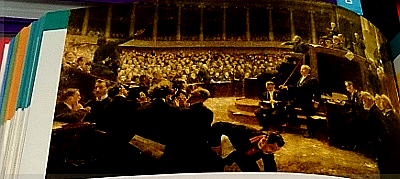
A PAGE FROM A 2016 SCHOOLBOOK


A MAJOR ERROR, PLUS OMISSIONS, PLUS POINTLESS DATA

An unforgivable mistake: "The latter [Thiers] seizes the cannons to disarm the capital." No! He tries to do so, fails and flees, leaving the vacuum that allows La Commune. 

As well, what cannons? 


Other schoolbooks may not have made as flagrant mistakes, but all have the same point of view.

La Commune (1871)

  • Pointless erudition: "Provisional Chief of the executive power:" No explanation is given for the clumsy title,* which takes up more than a full line in the short text. 
* It left the form of government open, in hopes of restoring monarchy later.

  • A major omission:  It [The Commune] takes measures that are social (free schooling) and anti-clerical (nationalization of ecclesiastical property)." All western industrialized nations adopt those practices. Commune innovations that challenged the social hierarchy are left out. 

  • Glossing over massacre: "In May during 'Bloody Week,' the army crushes the Parisian revolt, executing between 20,000 and 30,000 people." The worst massacre to take place in Europe before the Shoah obtains one line more than the ponderous 'Provisional Chief of the executive power' title.

A choice of illustration shows La Commune seen mainly as a prelude to the Third Republic. 


That the Republic was at least as conservative
as a monarchy would have been
is not said.

*     *     *

Monday, January 19, 2015

CORRECT THE ERRORS, BUTTRESS THE ADS


SOCIAL FORCES ARE ABSENT AND A LONE INDIVIDUAL REPLACES THE MASSES  

French school programs follow a national model. These textbook covers of 2025 differ, but the point of view is the same: 

Top-hatted men behind the well-dressed woman underscore the privileged and dominate the figure with the cap. The soldiers in the trenches of World War I are classless and isolated. A woman's face indicates an individual story. An industrial scene shows chimneys, not a strike.  

     Isolated figures
 
# # #

La Commune, a civil war with no social content: 


The Paris Commune:
A civil war (1871)

Legislative elections bring monarchists to power, who choose Adolphe Thiers as head of the government. Thiers allows the German army to have a march of triumph in Parischooses Versailles as the new capital and stops paying the National Guard. He is ready to sign peace with Germany.

Absent:
  • Ending the moratorium on paying rents, reimbursing debt and pawnbroker sales: disastrous for the poor when unemployment remains high.
  • Transferring the government to Versailles means that businesses on the verge of bankruptcy lose a clientele of over 600 deputies, their families and servants. 

# # #

Parisian determination to pursue the war with Prussia:


In contrast to the provinces, Paris voted massively of republican candidates and for the pursuit of the war and oppose Thiers. Most battalions of the garde refuse to accept the authority of Versailles.

Absent:
  • The incompetence of many generals and the widespread suspicion of their treason.
  • The suicidal Buzenval attack.
  • The shooting of January 23.
  • The belief that Versailles preferred peace with the Prussians to accepting Parisian social demands.

# # #

The conflict


Picture of Louise Michel: more below.

On March 18 1871, the drama explodes. Thiers orders the National Guard to take hold of the cannons on the Montmartre hillside. Furious, the Parisians oppose that, as does Louise Michel. Thiers orders his troops to leave the town, to besiege it. The whole city revolts and representatives of the Commune of Paris who adopt the red flag in replacement of the tricolor.

# # #

La Commune: one sentence, and transformative measures left out

[Paris wants to] be free, govern itself, invent a new society: separate Church and State, secularize schools, liberate the press, open museums to the public.

Omitted:

  • That these changes inevitable with industrialization, the free museums excepted. The Republic adopts them a decade later.
  •  La Commune's transformative measures: Women's cooperatives, worker-run enterprises whose owners had left, public establishments run by employees (decree in préparation).

# # #
 
Violence: acknowledge that of the army*...

*Obligatory, given the appellation "Bloody Week:"

Wishing to get it over with,* Versaillais troops enter Paris [and engage in a violence] without limits during Bloody Week (May 21-28 1871), leading to at least 10,000 dead. Judicial sessions succeed military repression with condemnations to death, to prison or else  — as for Louise Michel — to New-Caledonia (see chapter 8 p. 240).

 *A suggestion that the unprecedented ferocity was rational.

Omitted:

...and put the six executions by a single Communard fanatic on par with it:  

"The Communards too plunge into a revolutionary logic of violence [what?] , with the execution of several hostages." 

How can "several" compare with "at least 10,000?" The writer does not care enough to think through his (or her) account. 


# # #

A single figure, Louise Michel, replaces all the Communards: 

Left, her arrest. Right, the fires associated with La Commune, with no mention of the army's equal responsibility.


Alternative: 

Zoom (please scroll down) 
  "Construction workers' homage to our elders who died for la Commune."
Louise Michel (shown on the banner to the left) is one of many Communards.  

Underscoring a single actor enlivens an account...

  
...that divorced from concrete interests is incomprehensible and reinforces the chimerical individualism that huge companies use ads to promote.


Corner of rues de Tolbiac and Nationale, 13th

For how all aspects of a culture
reinforce the elites
please click here for Old Regime France
and here for us.

*     *     *
Next, 


Sunday, January 18, 2015

THE CARNAVALET BEFORE RENOVATION (in 2016-2022)...


IN 2010 THIS EYE-LEVEL PLAQUE WAS INSTANTLY VISIBLE
 
In 2016 it had been moved to a dark corner near the floor and I had to search to find it... 

"The fights that marked the end of the Commune were extremely violent, the Versailles troops shooting without judgement all the subjects they arrested. General Mac-Mahon, chief of operations, admitted 17,000 executions, a number that should doubtless be raised."

La Commune occupied two minuscule rooms at the back of the third floor. The first room...

  • Showed four paintings of fires associated with Communards.... 

The Fires of 1871 by Gustave Boulanger, 1871 / zoom

Zoom

     Zoom

Zoom
As with earlier combat scenes, violence merged into the city scape. There was no reference to destruction by the army.  

  • ...and one work from a Communard perspective:

  Execution of a Drummer Boy during the Commune by Alfred Roll / zoom

# # #

The second room was sunlit, 
and devoted to portraits 
of Versaillais generals or government leaders.

*     *     *

Next,