Sunday, October 22, 2017

TYCOONS ALMOST EQUAL TO AN EMPEROR


ROTUNDA AND VOIDS OF THE SAME IMPORTANCE SURROUND ENTRANCES OF EMPEROR AND ABONNÉS
 
Except for announcing Napoleon III on the facade, the edifice suggests that he and they are similar. 

      Claude Abron
One combination is for the Emperor, the other for the abonnés, on the city's most expensive land. 

The voids:

  • A ramp for horses highlights that of the Empereur, a colonnade the abonnés'.   


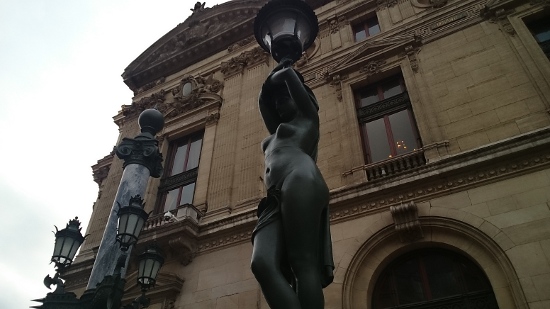
      • Caryatides emphasize both entries. A pair clothed in drapery flank that of the  Emperor...


      And 14 nude statues surround that of the abonnés. Before their restauration in 2016 they radiated a discreet sensuality... please read on.

       Félix Sinpraseuth

           Alex Varenne

      "Coming, honey?" 

      In official art gods with their idealized bodies represent the Republic, Justice etc. and as cold abstractions do not incite desire. The other example of sensual nudes on buildings of the time is Carpeaux's realistic female reveler in The Dance, on the Opéra's facade. There are no more.

      The figures allude to the ballerinas and emphasize the void's immensity. 


      Roland Halbe-Yatzer

      Lit by the caryatids' lanterns 
      the magnates would leave their carriages
      in the giant parking lot 
      and feeling themselves masters of the universe,
      stroll toward their entrance
      for business contacts and meetings with the girls.

      *     *     *

      Next,


      IGNORING THE OBVIOUS AND GETTING AWAY WITH IT


      THE PAINTING OF AN ORGY COVERS THE WHOLE CEILING OF THE ABONNÉS' SALON

      Its most explicit scene strikes the eye on entering.


      Yet:
       
      • The audio-guide comments minor elements of decoration (busts and small tapestries) and mentions neither subscribers nor ceiling.  
      • Guided tours say nothing. I've been in the salon a number of times with visitors and when a group arrives we've listened. The guide omits the ceiling and clients do not ask.

      Web site comments show only one visitor's surprise at such decor in one of high culture's great achievements.


      Harald Wolff

      The Opéra performs the exploit of turning
      profit-seeking and pedophilia into grandeur — 
      and (most of) the public,
       that of ignoring it.

      # # #

      Next,


      Saturday, October 21, 2017

      MASKING THE MONUMENT'S PURPOSE


      THE HOMAGE TO MAGNATES IS CAMOUFLAGED OR IGNORED

      Their entrance has almost vanished:


      The arrow may show its location, though I recall a simpler door at the rear of empty space. I did not think of taking a picture. 

      The restored statues are hard, slick and cold rather than almost palpable


      # # #

      How mask the void where the abonnés left their carriages and that underscored their entrance? Two-thirds of the space is neutralized...

        • The northern section is hidden until late afternoon because the light is in one's eyes. One sees the colonnade and does not think of the void: 


        • The center is a restaurant terrace. Tables and parasols divide its immensity while greenery and a barrier separate it from the street:


        • Passers-by do not notice it:


      # # #

      But the last third was too big to hide. 

        • Empty, it stood out. Tables and parasols briefly occupied the full space, but many more clients would have been needed to fill it. So it was abandoned.


        • Originally visitors had exited through a vast glass portal, descended a staircase that was short but wide, walked through the whole space and left with a sense of majesty.  .

      Toward 
      2019 a small, dark exit led visitors directly to the street. 

      It is one of the innumerable details that seem unimportant, and that can reveal what counts most. 

      But there was nothing to be done 
      about spectators from outside. 


      Or so it seemed.

      *     *     *

      Next,


      Wednesday, October 18, 2017

      THE DONORS' VOID NOW


      PLEASE CLICK BACK TO "WILLFULLY DESTROYING THE PAST"


      End of this section

      *    *    *

      Next section,


      Wednesday, August 30, 2017

      II.8. FROM NYMPHS TO NAZIS — HOW THE OPÉRA GIRLS SAVED THE CITY OF LOVE

      .
      THE "LITTLE DANCERS' " GIFT TO PARIS
       
      The book and movie "Is Paris burning?" inspired this end. 

      Book, Larry Collins and Dominique Lapierre, 1965.
      Movie, directed by René Clément, music by Maurice Jarre, 1966,
       French-American cast: Orson Welles, Kirk Douglass, Tony Perkins...
      Alain Delon, Jean-Paul Belmondo, Simone Signoret...

      Pamela Spurdon


      In brief

      *    *    *
      Next,
      Place Vendôme and the Occupation


      Tuesday, August 29, 2017

      PLACE VENDÔME AND THE OCCUPATION


      ON LEAVING THE OPÉRA, TAKE RUE DE LA PAIX TO PLACE VENDÔME 

                Adapted from Mappy

      Notice the luxury establishments...  

       The Cartier flagship store.

      And the world-known jewelers on place Vendôme itself: 
       

      # # #
       
      Jean Beraud painted elegant Paris at the turn of the 19th century. He showed the entry to the dressmaker Paquin (on the site of Cartier now) three times, and a fourth of shopping.  

                            Rue de la Paix, gone from the web

        Rue de la Paix / zoom

            Workers Leave the Paquin establishment, rue de la Paixzoom

        Shopping on rue de la Paix / zoom

      Jewelers moved there from Palais-Royal when steamships encouraged the tourism of the wealthy (toward 1880). So that is where the great hotels sprang up, starting with the Hôtel Ritz on place Vendôme itself (in 1898).

                New Year's Eve at the Hotel Ritz in 1930, "The Ritz of Paris" by Stephen Watts (ed. Bodley Head) 1964

      # # #

      During the Occupation, those hotels were where the German officers settled:*

      *But not the Gestapo, which stayed at the Lutétia across the river: Noble officers and lower-middle-class police did not mix. 


      Lunch menu, 
      four days after occupying Paris
      It shows the officers' pride in speaking French. (The writer does not know the French word for grapefruit, so says "grap fruit.")

      Rommel, Commander of the forces in Normandy

      Goebbels, Minister of Propaganda and a French collaborator. Notice the body language. 

      Goering, next after Hitler

      "We must assume our past," 
      said Manager Claude Roulet
       when he let me use these photos
       from the hotel archives.

      *    *    *

      Next,


      Monday, August 28, 2017

      WHY PARIS DIDN'T BURN


      AS THE ALLIES APPROACHED THE CITY HITLER NEEDED A COMMANDER OF WHOM HE COULD BE SURE

      He chose General Dietrich von Choltitz, who had razed Rotterdam and laughed as he forced Russians to bombard their own homes:


      When Parisians rose up to free Paris themselves, Hitler ordered Choltitz to destroy it, Notre-Dame and the Louvre included.

          Is Paris Burning? Trailer

      The commander had mines placed everywhere, including under the bridges. Blowing them up would flood the city and drown one or two million of its three million people:
       -- According to the Franco-German movie Diplomacy 
      by Volker Shlondorff with Niels Arestrup and Andre Dussolier, 2014

      Diplomacy trailer

      Hitler telephoned Choltitz eight times, screaming, Paris brennt?
      ("Is Paris burning?"). A
       few days later he ordered Warsaw blown up meter by meter, as punishment for its uprising:

      Start of the Polish film Kanal by Andrej Wajda, 1958

      Choltitz eluded the order: "Ja, mein Fuhrer, I'm going to do it,
      as soon as I've evacuated the German wounded..." "I'm still evacuating them..."

      He passed a message to the Allies, imploring them to come immediately before Hitler replaced him:

      Is Paris Burning? trailer

       They had meant to skirt Paris, but changed their plan:

       Jack Downey, U.S. Office of War Information / zoom
                                                                                            
      Crowds of French patriots line the Champs Elysees to view General Leclerc's 2nd Armored Division passing through the Arc du Triomphe, after Paris was liberated on August 26, 1944.

      Choltitz survived the war. When asked 20 years later why he broke his oath of obedience, he answered, 

      "I was a soldier, not a criminal. If I had thought that destroying Paris would help Germany win the war, I would have done it without a second's hesitation. But I knew it was lost, and I did not want to go down in History as the person who destroyed such beauty."

      # # #

      He 
      lived on the fourth floor 
      of the Hôtel Meurice, minutes from place Vendôme. From his windows he viewed this sublime panorama:  
      Claude Abron
      The view extends far to the south and west, beyond the Eiffel Tower.

      The ripples of the past are endless:

      • Choltitz saves Paris because its beauty moves him.
      • The view from his hotel windows allows that contemplation. 
      • The hotel is on that site to be near the jewelers' wealthy patrons.
      • The jewelers are there to be near their international clientele. 
      • For many of those visitors a tryst with a ballerina is part of the Parisian experience.

      The ballerinas demand jewels...

      So we should say,
      "Thank Heaven for little girls!"

      Degas exhibit at the musée d'Orsay

      End of this chapter on famous
      aspects of the city.
      The next is on what is usually omitted.

      *     *     *